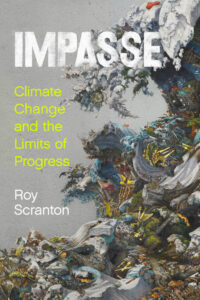
“Impasse is far-reaching, compelling, and daringly pessimistic. it confronts what we don’t know about the future with unusual honesty and clarity.” —Elizabeth Kolbert, author of The Sixth Extinction
“Standing firmly against the dominant American social position that we must be optimistic—we must ‘remain hopeful’— Scranton argues that an objective pessimism may just be our best tool for addressing and moving forward in the climate crisis. A powerful and provocative work.” —Naomi Oreskes, author of Merchants of Doubt
“Scranton’s work is imaginative, intelligent, courageous, and honest in a rare way, and Impasse is a well-researched and, in some ways, even inspiring exploration of pessimism. Even those disagreeing with Scranton’s argument will come away enriched.” —Dipesh Chakrabarty, author of The Climate of History in a Planetary Age
“Roy Scranton has written an elegant and elegiac meditation on climate change. Literary, philosophical and by turns fiercely political and searingly personal, Impasse is an extraordinary book.” —Wendy Brown, author of In the Ruins of Neoliberalism
“Roy Scranton brings enormous erudition and a great deal of philosophical sophistication to bear on some of the knottiest aspects of our accelerating planetary crisis.” —Amitav Ghosh, author of The Great Derangement
“Roy Scranton is one of the few essential environmental writers.” —Dale Jamieson, author of Reason in a Dark Time
“Impasse pushes us down, drowning, into viscous significations, choking us, knowing only our drowning, but there, at the end, we see it: ‘the hope that life might be worth living after the end of the world.’ I’m not sure we have a choice.” —Anna Tsing, co-author, Field Guide to the Patchy Anthropocene: The New Nature
“Provocative…. Readers will find startling insights here.”—Publishers Weekly
From the author of Learning to Die in the Anthropocene and the novel War Porn comes a bracing argument for how to face our global crisis.
Extreme heat, fires, floods, and storms are transforming our planet. Yet instead of serious responses from world leaders, we get increasing emissions, divisive politics, and ersatz solutions that offer more of the same: more capitalism, more complexity, more progress.
The impasse we face is not only political and institutional, but cognitive, existential, and narrative. We’re incapable of grasping the scale, speed, and impact of global warming. Our brains can’t make sense of how radically our world is changing. And we optimistically cling to a civilizational narrative that promises a better tomorrow if we just keep doing what we’re doing.
It’s well past time, Roy Scranton argues, to free ourselves from our dangerous and dogmatic faith in progress. Such unwarranted optimism will only accelerate our collective disintegration. If we want to have any hope at all for the future, it must be grounded in a recognition of human limits—a view Scranton calls ethical pessimism.
Drawing from psychology, philosophy, history, and politics, as well as film, literature, and personal experience, Scranton describes the challenges we face in making sense of our predicament, from problems in communication to questions of justice, from the inherent biases in human perception to the difficulties of empirical knowledge. What emerges is a challenging but ultimately hopeful proposition: if we have the courage to accept our limits, we may find a way to embrace our unknowable future.
ORDER: Amazon | B&N | Stanford University Press